
NEW RELEASE: Rochela (Raw Cello) for nine violoncelli
Rochela (Raw Cello). Germán Marcano, cello. Also featuring chamber arrangements of other works by Venezuelan composers. Esperanto CD Systems, Venezuela, 2011.
Rochela (Raw Cello). Germán Marcano, cello. Also featuring chamber arrangements of other works by Venezuelan composers. Esperanto CD Systems, Venezuela, 2011.
A year after its first performance at Michigan State University, Ricardo Lorenz’s Viola Concerto received its East Coast premiere on October 15, 2011. This time it was outside of Philadelphia, once again with violist Roberto Díaz for whom the concerto titled Canciones de Jara was especially composed, and this time accompanied by Symphony in C, a recently created professional training orchestra lead by conductor Rossen Milanov. Lorenz’s concerto opened the orchestra’s 2011-2012 season along with staple works from the symphonic repertoire such as Listz’s Mephisto Waltz No. 1 and Berlioz’s Symphonie Fantastique.
Though there appears to be a tension between the song short form -simple, with alternating verses and choruses- and the large symphonic form developed during the classical era in Europe, Lorenz uses Canciones de Jara to resolve some of those contradictions and explore the deeper meanings of Jara’s songs. ‘That’s what the symphonic context allows,’ he says. Courier Post’s Dave Allen previewing the East Coast premiere of Lorenz’s Canciones de Jara with Roberto Díaz and Symphony in C, conducted by Rossen Milanov. Read entire article published in the CourierPostOnline.com
Compass Points. The Verdehr Trio: Walter Verdehr, violin; Elsa Verdehr, clarinet; Siliva Roederer, piano. Included in Vol. 19 of The Verdehr Trio series “The Making of a Medium.” Crystal Records, US, 2011
El Muro. University of North Texas Wind Symphony; Eugene Corporon, conductor. Included in a CD titled “Revelations” containing other works by Higdon, Grantham, and Reed. GIA Publications, US, 2011.
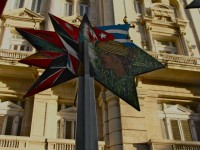
When one thinks of Cuba, one thinks of three things: tobacco, revolution, and music. However, of these three emblems, music best defines the identity of the country. Since more than a century and a half, music has allowed Cubans to remain attached to the past while at the same time respond to influences and demands from the present. Throughout the dramatic history of Cuba —which includes slavery, independence from Spain, U.S. interventions, and a socialist-communist revolution among others—, music has always been there for Cubans to not only record events but to also adapt to them. During a five-week study
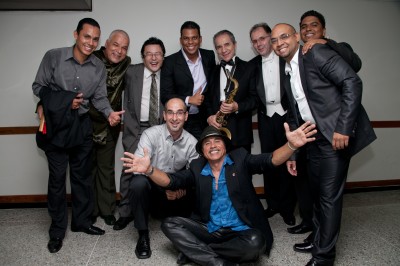
Rumba Sinfónica, a thirty-minute concerto of sorts for Latin band and symphony orchestra, was the result of a close collaboration between composer Ricardo Lorenz and pianist/arranger Jorge Gómez. Since its premiere with the Minnesota Orchestra in the fall of 2007, Rumba Sinfónica has been performed two dozen times by Jorge Gómez’s band Tiempo Libre and different professional, college, and youth orchestras across the U.S. and Canada. For the 2010-2011 season, Rumba Sinfónica traveled over the Atlantic Ocean and over the Mediterranean and Caribbean seas to receive premieres in Israel and Venezuela. On November 3, 2011, two-time Grammy nominated Tiempo Libre performed the
Continue reading…Rumba Sinfónica premieres in the Middle East and South America
As a guest composer of the 2nd Congress of Musical Creation hosted by the Conservatory of Music of Puerto Rico in San Juan, Ricardo Lorenz attended the Caribbean premiere of his work Merengue en el Espejo and delivered a two-part lecture presentation on the topic of finding appropriate spaces for optimal musical creation. The Conservatory of Music’s composition faculty Alfonso Fuentes organized the multidisciplinary event that gathered composers and performers as well as visual artists, authors, musicologists, and folklorists during the dates of February 10-13, 2011. Founded by the famous cellist Pablo Casals, the Conservatorio de Música de Puerto
Continue reading…Second Congress of Musical Creation in San Juan, Puerto Rico